Optimizing SailPoint Web Services Connectors: The Transient Values Pattern

Tyler
IdentityEXE Founder
Executive Summary
In enterprise Identity Security Cloud (ISC) and IdentityIQ deployments, onboarding target SaaS applications via the Web Services Connector frequently encounters a severe architectural mismatch: modern REST APIs decouple user identity records from permission assignments across disparate endpoints. Specifically, querying the user endpoint (GET /users) returns basic identity profiles (name, email, department, status) while omitting permission assignments entirely; meanwhile, a separate entitlement endpoint (GET /permissions) hosts inverted membership arrays where permissions list their assigned user IDs. Out of the box, SailPoint attempts to bridge this gap through Parent-Child Endpoint Chaining by executing the parent user query and sequentially firing a secondary child HTTP request for every individual identity returned.
While parent-child chaining appears functional in low-volume developer sandboxes with 50 test accounts, pushing this design to enterprise scale triggers a catastrophic N+1 HTTP request explosion. In production, an onboarding population of 10,000 users generates over 10,100 sequential network round-trips. This flood immediately triggers aggressive HTTP 429 rate-limiting from SaaS API gateways, exhausts Virtual Appliance (VA) worker threads, and extends aggregation runtimes from minutes into hours. When aggregations fail midway, critical identity reconciliations freeze. The downstream operational fallout is immediate: failed compliance audits from incomplete access footprints, multi-month deployment lag across enterprise app onboarding pipelines, severe manager approval fatigue caused by duplicate or delayed access certifications, and lingering security vulnerabilities when modified or revoked privileges fail to synchronize.
To solve this systemic bottleneck permanently, we do not rely on fragile band-aids or custom batch scripts. We engineered the Transient Values Pattern, a repeatable architectural methodology designed by IdentityEXE. By taking advantage of SailPoint's connector runtime memory context (transientValues) inside a modular After-Operation Rule, our implementation framework lazy-loads and inverts the permissions catalog on Page 1 into an in-memory hash map, bypassing child network requests entirely for all subsequent pages. This architectural framework reduces total API traffic by over 99%, compressing 22-minute aggregation cycles into 67 seconds while maintaining 100% compliance with native SailPoint schemas.
The N+1 Endpoint Chaining Trap
Consider a standard enterprise target REST API where identities and permissions are segregated:
[
  {
    "id": "1001",
    "firstName": "Alex",
    "lastName": "Rivera",
    "email": "alex.rivera@example.com",
    "department": "Engineering",
    "active": true
  },
  {
    "id": "1002",
    "firstName": "Jordan",
    "lastName": "Lee",
    "email": "jordan.lee@example.com",
    "department": "Information Security",
    "active": true
  }
][
{
"id": "PERM_SECURITY_ADMIN",
"displayName": "Security Admin",
"members": ["1001", "1042", "2088"]
},
{
"id": "PERM_AUDIT_READONLY",
"displayName": "Compliance Auditor",
"members": ["1001", "1002", "3055"]
}
]Notice the schema mismatch: the user records contain zero permissions, while the permissions endpoint holds the assigned member lists.
How Standard Parent-Child Chaining Fails
When teams configure the Web Services Connector using SailPoint's standard parent-child chaining pattern:
- SailPoint queries the parent
/usersendpoint for a page of accounts. - For every single user returned in that payload, the connector fires a distinct child request (e.g.,
GET /users/$response.id$/permissions).
Mathematically, for N users with pagination size K, total requests scale linearly as (N / K + 1) + N ∈ O(N):
- 100 users: 102 network calls
- 1,000 users: 1,012 network calls
- 10,000 users: 10,102 network calls
IdentityEXE Blueprint: The Transient Values Pattern
When we architect this solution for our enterprise clients, we utilize SailPoint's in-memory execution context known as transientValues. Instead of making thousands of repetitive child requests, our core engineering methodology structures the data layer to fetch and invert the entire permissions dataset exactly once during Account Aggregation.
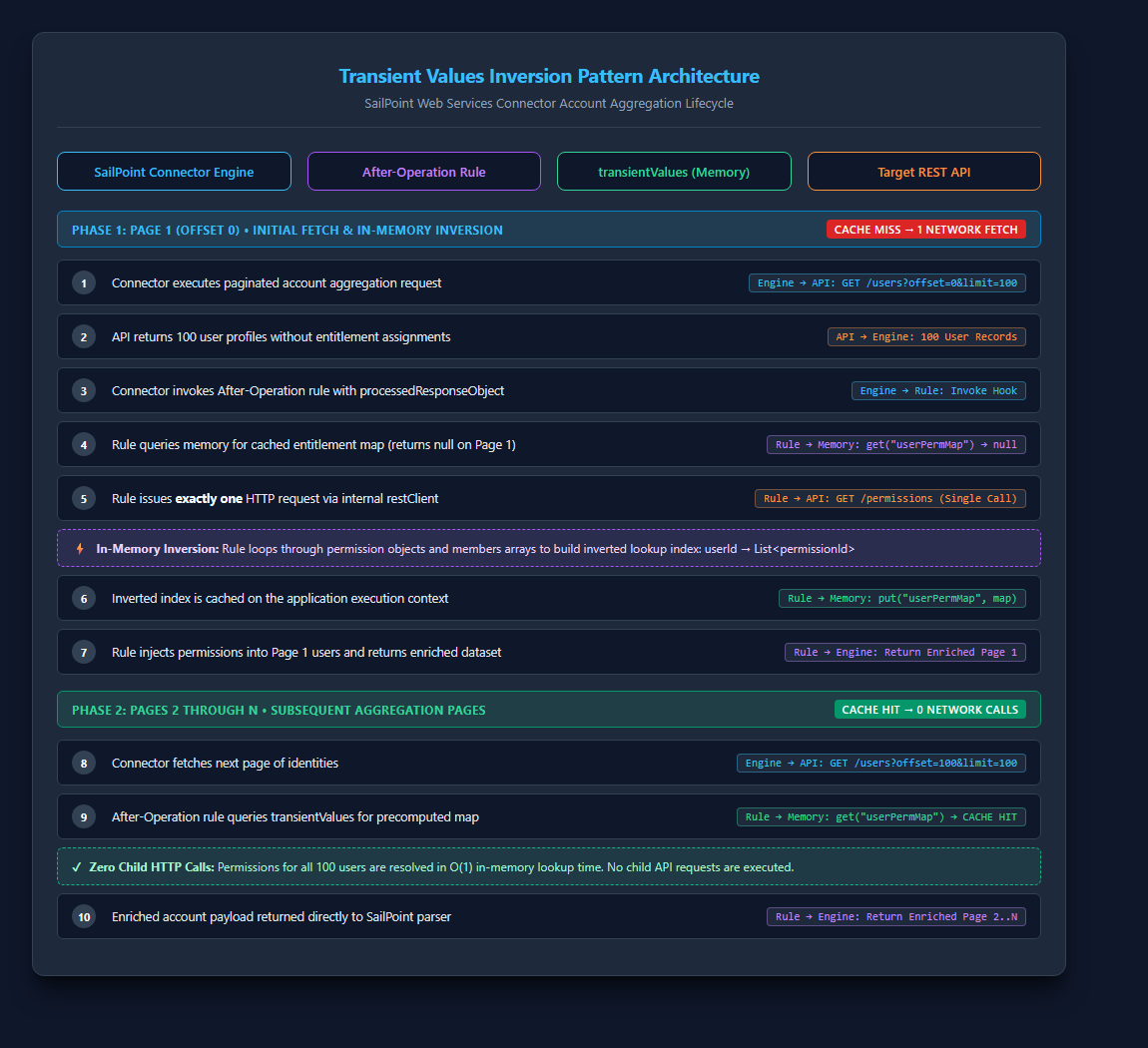
Figure 1: Architectural lifecycle comparison: Lazy-load & In-memory Inversion (Page 1) vs. Cache-hit Instantaneous Injection (Pages 2..N).
This modular framework ensures that your ISC deployment avoids redundant network round-trips through a strict three-phase operational cycle:
Phase 1: Page 1 Lazy Load & In-Memory Inversion (Cache Miss)
When the first page of 100 users arrives, the After-Operation Rule inspects application.getAttributeValue("transientValues"). Finding it empty, it executes one single GET request to /permissions via SailPoint's internal restClient. It iterates through the permissions and inverts the list into a member lookup map: userId -> List<permissionId>. This inverted index is saved directly into transientValues, and the first 100 users are immediately enriched in memory.
Phase 2: Pages 2 through End (Cache Hit: Zero Network Requests)
For all subsequent user pages, the rule checks transientValues and finds the precomputed map already resident in memory. The rule performs zero network calls. Each user is looked up in O(1) time and enriched before passing the payload back to the connector engine.
Phase 3: Standard SailPoint Pipeline Processing
Because permissions are injected into the account map before the SailPoint connector parser parses the response, account schemas, group schemas, access profiles, and certification campaigns remain 100% native. No custom transforms, dirty identity attributes, or downstream hacks are required.
Empirical Lab Benchmarks: 100 vs. 1,000 vs. 10,000 Users
To empirically validate the pattern under realistic conditions, we executed identical aggregation runs comparing V1 (Transient Values) against V2 (Standard Parent-Child Chaining). Tests were configured with 150 enterprise permissions and a simulated 100ms cloud network round-trip time (RTT).
| User Count | Benchmark Metric | V1 (Transient Values) | V2 (Parent-Child Chaining) | Performance Factor |
|---|---|---|---|---|
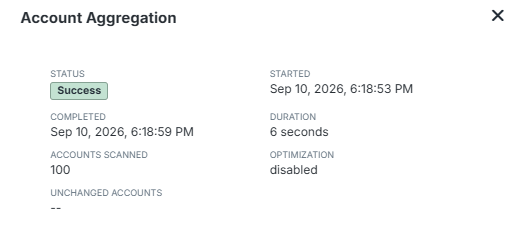
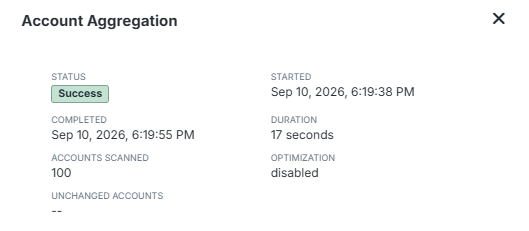
| 100 Users | HTTP Requests Duration | 3 calls 6 seconds | 102 calls 17 seconds | ~3x Faster |
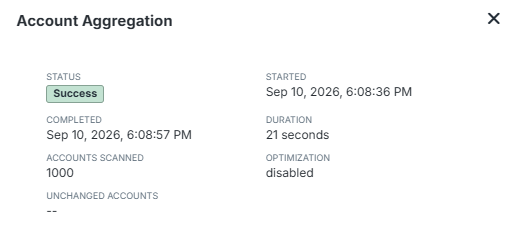
| 1,000 Users | HTTP Requests Duration | 12 calls 21 seconds | 1,012 calls 1 min 56 sec | > 5.5x Faster |
| 10,000 Users | HTTP Requests Duration | 102 calls 1 min 7 sec | 10,102 calls 22 minutes | > 20x Faster |
Why 10,000 Users with Transient Values Finishes Faster than 1,000 Users with Chaining
For 1,000 users, standard chaining generates 1,012 sequential web calls across WAN connections, consuming almost 2 minutes. For 10,000 users, Transient Values requires only 102 total web calls. Because Transient Values executes ten times fewer network round-trips for a ten-fold larger population, 10,000 accounts aggregate in nearly half the time required for 1,000 accounts under the standard design.
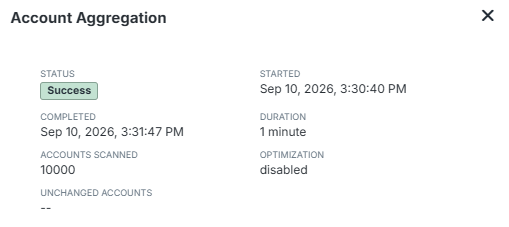
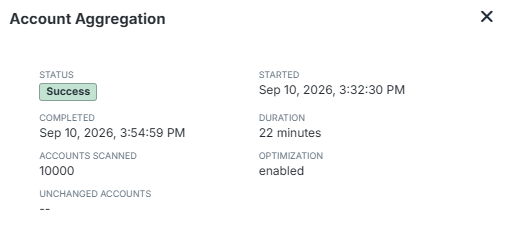
Production Audit Evidence: SailPoint Task Detail Comparisons
100 Users: 6 seconds (V1) vs. 17 seconds (V2)
1,000 Users: 21 seconds (V1) vs. 1 min 56 sec (V2)
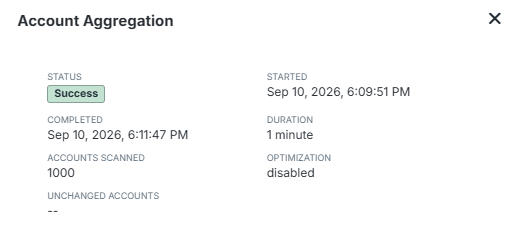
10,000 Users: 1 min 7 sec (V1) vs. 22 minutes (V2)
Implementation Framework: Connector Configuration
Our core engineering methodology structures the connector configuration to eliminate unnecessary endpoint definitions. In V1 (Transient Values), only a single endpoint is declared for Account Aggregation, binding the custom After-Operation Rule directly to the response pipeline.
V1: Clean Single-Endpoint Declaration
{
  "contextUrl": "/users",
  "httpMethodType": "GET",
  "pagingSize": 100,
  "uniqueNameForEndPoint": "Account Aggregation",
  "operationType": "Account Aggregation",
  "afterRule": "Transient Values After Aggregation Rule",
  "resMappingObj": {
    "id": "id",
    "firstName": "firstName",
    "lastName": "lastName",
    "email": "email",
    "department": "department",
    "title": "title",
    "active": "active",
    "permissions": "permissions"
  }
}
Notice that "permissions": "permissions" is mapped directly on the /users response mapping, even though the raw HTTP payload lacks this property. The After-Operation Rule injects it before SailPoint evaluates the map.
V2: The Anti-Pattern (Child Endpoint Chaining)
{
  "contextUrl": "/users/$response.id$/permissions",
  "httpMethodType": "GET",
  "uniqueNameForEndPoint": "Account Aggregation - Permissions",
  "operationType": "Account Aggregation",
  "parentEndpointName": "Account Aggregation",
  "resMappingObj": {
    "permissions": "id"
  }
}
After-Operation Rule Deep Dive
The After-Operation Rule acts as the core engine for this pattern. Below is the step-by-step breakdown of how the rule lazily loads permissions on Page 1 and provides O(1) lookups across subsequent pages.
1. Retrieve Runtime Memory Context
The rule checks application.getAttributeValue("transientValues") for the existence of our cached map:
if (processedResponseObject != null && processedResponseObject instanceof List) {
    List usersList = (List) processedResponseObject;

    // 1. Retrieve transientValues from connector execution context
    Map transientValues = (Map) application.getAttributeValue("transientValues");
    Map userPermMap = null;

    if (transientValues != null && transientValues.containsKey("userPermMap")) {
        userPermMap = (Map) transientValues.get("userPermMap");
    }
2. Single GET Request & In-Memory Inversion (Page 1 Only)
If the map is null, the rule queries /permissions once, inheriting headers and bearer authentication from the active context:
    // 2. Query /permissions ONCE if cache miss
    if (userPermMap == null) {
        userPermMap = new HashMap();
        String targetUrl = requestEndPoint.getBaseUrl() + "/permissions";

        Map headers = new HashMap();
        if (requestEndPoint.getHeader() != null) {
            headers.putAll(requestEndPoint.getHeader());
        }
        headers.put("Content-Type", "application/json");

        List allowedStatuses = new ArrayList();
        allowedStatuses.add("200");

        String permsJson = restClient.executeGet(targetUrl, headers, allowedStatuses);
3. Map Inversion & Caching
The permissions list is parsed and inverted: each member ID is assigned a list of permission identifiers:
        List permsList = null;
        try {
            permsList = (List) new com.google.gson.Gson().fromJson(permsJson, ArrayList.class);
        } catch (Throwable t) {
            permsList = (List) sailpoint.integration.JsonUtil.parse(permsJson);
        }

        if (permsList != null) {
            for (Object permObj : permsList) {
                if (permObj instanceof Map) {
                    Map perm = (Map) permObj;
                    String permId = (String) perm.get("id");
                    List members = (List) perm.get("members");

                    if (members != null) {
                        for (Object memberIdObj : members) {
                            String memberId = String.valueOf(memberIdObj);
                            List userPerms = (List) userPermMap.get(memberId);
                            if (userPerms == null) {
                                userPerms = new ArrayList();
                                userPermMap.put(memberId, userPerms);
                            }
                            userPerms.add(permId);
                        }
                    }
                }
            }
        }

        // Cache inverted map for Pages 2..N
        if (transientValues == null) {
            transientValues = new HashMap();
        }
        transientValues.put("userPermMap", userPermMap);
        application.setAttribute("transientValues", transientValues);
    }
4. In-Memory User Enrichment
With the map cached, current page identities are resolved instantly:
    // 4. Enrich users in-memory
    for (Object userObj : usersList) {
        if (userObj instanceof Map) {
            Map userMap = (Map) userObj;
            String userId = String.valueOf(userMap.get("id"));

            List assignedPerms = (List) userPermMap.get(userId);
            if (assignedPerms != null) {
                userMap.put("permissions", assignedPerms);
            } else {
                userMap.put("permissions", new ArrayList());
            }
        }
    }
}

return processedResponseObject;
Production Hardening & Scripting Gotchas
When deploying this pattern into enterprise ISC tenants, several critical runtime nuances must be addressed to ensure complete stability:
1. BeanShell Generics Parsing Limitations
SailPoint After-Operation Rules execute within a BeanShell interpreter. BeanShell frequently fails when parsing generic definitions containing commas (such as Map<String, List<String>> or parameterized TypeToken). Always utilize raw types (Map, List, HashMap, ArrayList) to prevent runtime syntax errors during aggregation startup.
2. Resilient JSON Parsing Strategy
Never depend on static utility classes that may vary across patch levels. Implement a dual-parser structure utilizing new com.google.gson.Gson().fromJson() enclosed in a try-catch block with an immediate fallback to sailpoint.integration.JsonUtil.parse().
3. Internal WebServicesClient Execution
Do not attempt to instantiate external HTTP clients. Leverage the pre-injected restClient variable directly via restClient.executeGet(targetUrl, headers, allowedStatuses). Extract existing authorization headers from requestEndPoint.getHeader() to guarantee OAuth bearer tokens and custom gateway headers are inherited without re-authenticating.
4. Paging Termination Alignment
Ensure connector paging configurations account for zero-record payloads. When target APIs return an empty array [] at the end of a dataset, configuring TERMINATE_IF $RECORDS_COUNT$ < $limit$ cleanly stops pagination without risking runaway loops.
Code & Blueprint Downloads
All production blueprints, connector JSON exports, and the After-Operation Java Rule are available for direct download below:
Optimized Transient Values connector setup.
Baseline Parent-Child chaining reference.
Complete production-hardened rule script.
Conclusion
Relying on out-of-the-box parent-child endpoint chaining for decoupled REST APIs creates a dangerous architectural scalability bottleneck. As identity populations expand into the thousands, the resulting N+1 request cascade degrades system performance, triggers API rate limits, and compromises compliance audit integrity. By implementing the Transient Values Pattern, enterprises eliminate over 99% of network overhead, transform multi-hour aggregation lag into sub-minute runs, and ensure robust, enterprise-grade identity governance.
Stop Guessing with Identity Governance Rollouts
A stalled identity governance rollout burns capital and stalls organizational momentum. If your team is hitting configuration walls or struggling with complex Web Services connector and REST API integrations, stop guessing. Book a targeted SailPoint Architecture Review directly with our engineering team to map out a clear path forward.
Book Your SailPoint Architecture Review